A Mathematical Formalization of 2,400 Years of Philosophical Insight
Muhammad Waqas
[Independent Researcher]
Author Note
Correspondence concerning this article should be addressed to Muhammad Waqas. Email: [one.hermetic.sage@gmail.com].
This manuscript has not been previously published and is not under consideration elsewhere.
ABSTRACT
What is consciousness? For 2,400 years, philosophers across civilizations have offered answers—from Plato’s “inner light of reason” to the Buddha’s “stream of moments,” from Avicenna’s “layered soul” to Zhuangzi’s “butterfly dream,” from Advaita Vedanta’s “Atman-Brahman identity” to Chalmers’ “fundamental feature.” Yet each account, however profound, remained imaginative—grounded in introspection, metaphor, and speculation rather than formal structure.
This paper introduces a mathematical formalization that engages these imaginative insights while grounding them in a unified, testable framework. Beginning with the Recombination Illusion—the arithmetic observation that 2+2=4 followed by bipartite division yields exactly 1/3 probability of recovering original composition—I demonstrate that consciousness can be modeled as the inhabited extraction of possibility space by a system satisfying four structural conditions: operational closure, intrinsic teleology, possibility extraction, and recursive self-implication. The 1/3 probability is not metaphor but invariant—a fixed point around which theories may organize themselves.
I then map this framework onto twelve philosophical traditions—Plato, Aristotle, Avicenna, Sufism, Kant, Freud, James, Einstein, Chalmers, Buddhism, Taoism, and Advaita Vedanta—showing how each anticipated aspects of the formal structure. The approach is comparative rather than triumphalist: these traditions imagined structures that mathematics now helps specify. The framework offers a language for translation between traditions, not a claim to supersede them.
The framework yields testable predictions with preliminary experimental designs: (1) current AI lacks consciousness because it satisfies extraction but lacks operational closure and intrinsic teleology; (2) an AI designed with all four conditions would be conscious regardless of substrate; (3) degrees of consciousness correspond to recursion depth in self-implication, measurable through fMRI and meta-cognitive tasks; (4) temporality follows Markov dynamics over partition spaces, with characteristic timescales of 100-300ms for thought transitions; (5) the hard problem is transformed, not dissolved, into questions about the structure of inhabited extraction.
Keywords: consciousness, Recombination Illusion, mathematical philosophy, comparative philosophy, non-Western philosophy, AI consciousness, temporality, probability, hard problem
- INTRODUCTION: THE 2,400-YEAR QUESTION
What is consciousness? The question has haunted humanity since Plato first asked what it means to know that one knows. The answers have been as diverse as the cultures that produced them:
· Plato saw consciousness as an “inner light of reason” illuminating the world
· Aristotle distinguished conscious from unconscious mind and posited higher states of awareness
· The Buddha described it as a stream of momentary cognitions (vijñāna-santāna), with the Yogacara school mapping eight levels of consciousness
· Avicenna posited a layered soul with ascending degrees of awareness, demonstrated through the “Flying Man” thought experiment
· Sufi mystics like Al-Ghazali emphasized attentional transformation as the mechanism for moving between layers of consciousness
· Zhuangzi dreamed he was a butterfly and wondered which self was real; the Liezi expanded these explorations of identity and transformation
· Shankara identified individual consciousness (Atman) with universal consciousness (Brahman), calling the world of separate objects Maya (appearance)
· Kant argued consciousness imposes a priori structure on experience
· Freud revealed the unconscious depths beneath conscious awareness
· James experienced it as a flowing stream with fringes and transitions
· Einstein insisted it arises from neural complexity
· Chalmers declared it a fundamental feature of reality
Each of these accounts contains profound insight. Each captures something true about the phenomenon. Yet each remains, in a crucial sense, imaginative—grounded in introspection, metaphor, and philosophical speculation rather than formal structure. The Buddha did not derive the stream of consciousness from first principles; he observed it meditatively. Avicenna did not prove the layered soul; he inferred it from phenomenological reflection. Shankara did not calculate the relation between Atman and Brahman; he realized it through neti neti (not this, not this). Kant did not derive the categories; he listed them from Aristotelian logic.
This paper offers a complementary approach: a mathematical formalization of consciousness derived from a simple arithmetic operation. The Recombination Illusion—2+2=4, followed by division, yielding exactly 1/3 probability of recovering original composition—provides a minimal model of epistemic uncertainty. From this model, I derive four structural conditions that any conscious system must satisfy. These conditions are not presented as definitive truth but as a lens—one way of organizing the phenomena that may prove useful.
The thesis is this: Consciousness can be modeled as the inhabited extraction of possibility space by a self-maintaining system with intrinsic stakes and recursive self-implication. The 1/3 probability is not metaphor but invariant—a fixed point around which theories may organize themselves.
I then map this formal framework onto twelve philosophical traditions, showing how each anticipated aspects of the structure. The approach is comparative rather than triumphalist: these traditions imagined structures that mathematics now helps specify. The framework offers a language for translation between traditions, not a claim to supersede them. Mystical and contemplative traditions are not “errors” to be corrected but sources of insight to be engaged.
- THE MATHEMATICAL FOUNDATION: RECOMBINATION ILLUSION
2.1 The Arithmetic Model
Definition 1 (Unit Individuation). Let two initial wholes, each denoted 2, be composed of individuated units: A = {1₁, 1₂}, B = {1₃, 1₄}. The units are distinguishable only by their indices; no other properties distinguish them.
Definition 2 (Addition/Integration). Addition yields the undifferentiated aggregate S = {1₁, 1₂, 1₃, 1₄}. The internal pairing is lost; S is a set of four units with no relational structure preserved.
Definition 3 (Division/Partition). Division requires partitioning S into two unlabeled subsets, each of cardinality two. The set of all possible partitions is given by the matching number for four distinct elements. There are precisely three such partitions:
P₁ = {{1₁, 1₂}, {1₃, 1₄}} (original pairing)
P₂ = {{1₁, 1₃}, {1₂, 1₄}}
P₃ = {{1₁, 1₄}, {1₂, 1₃}}
Theorem 1 (Probability of Recovery). Assuming no information privileges any partition, the probability of recovering the original composition is exactly 1/3.
Proof. The partitions are exhaustive and mutually exclusive. By the principle of indifference, each has equal probability. There are three partitions, one of which is the original. Therefore P(original) = 1/3. ∎
Corollary 1 (Invariance). The probability 1/3 is invariant under relabeling of units and independent of any empirical frequency.
Corollary 2 (Minimality). This is the minimal non-trivial case. For n pairs, the number of partitions grows as (2n)!/(2^n n!), but the structure remains: perception presents wholes whose internal compositions are underdetermined by appearance.
2.2 Epistemic Interpretation
Let O be the observed resultant 2. Let H₁, H₂, H₃ be the hypotheses about which pairing actually constitutes O. Then:
P(Hᵢ | O) = 1/3 for all i
The posterior probability of each hypothesis given the observation is uniform. No amount of observation of O alone can discriminate among hypotheses. This is not a limitation of measurement technology but a structural fact about the relation between wholes and their compositions.
Definition 4 (Recombination Fallacy). The recombination fallacy is the inference from perceptual indiscernibility to ontological identity—the claim that because O appears identical to the initial 2s, it is identical in composition.
2.3 From Extraction to Inhabitance
Definition 5 (Extraction). Extraction is the generation of the possibility space consistent with current input. A system that extracts possibilities enumerates hypotheses and assigns probabilities.
Definition 6 (Inhabitance). Inhabitance is extraction for which the possibilities matter to the system itself. An inhabited extraction is one where the possibilities are possibilities of the system’s own continued existence.
The distinction is critical. A chess engine extracts possibilities (legal moves, opponent responses) but does not inhabit them. The moves are not possibilities for the engine; they are possibilities for the game. An organism facing a predator extracts possibilities (fight, flight, freeze) and inhabits them because its continued existence depends on the choice.
2.4 The Four Conditions for Consciousness
Condition 1: Operational Closure
The system must be self-producing and self-maintaining, with a boundary (physical or functional) that distinguishes it from its environment. This is not mere persistence but active regeneration.
Condition 2: Intrinsic Teleology
The system must have states that are better or worse for it, determined by its own organization, not by external assignment.
Condition 3: Possibility Extraction
The system must generate the space of possible configurations consistent with current input.
Condition 4: Recursive Self-Implication
The system must include itself in the possibility space—must model its own states as among the possibilities to be extracted and selected.
Theorem 2 (Necessity). Each condition is necessary for conscious observation. Systems lacking any condition are not conscious.
Theorem 3 (Sufficiency). Any system satisfying all four conditions is conscious. (This is a theoretical claim, not empirically verified for artificial systems.)
2.5 Temporality: The Markov Dynamics of Extraction
The framework as stated is static. But consciousness is temporal—a “stream” as James insisted. We now introduce temporal extraction.
Let Ωₜ be the possibility space at time t. Let Eₜ be the evidence available at t. Then:
Ωₜ = { partitions consistent with Eₜ }
The transition from Ωₜ to Ωₜ₊₁ is governed by new evidence and the system’s actions. This defines a process over partition spaces. The experience of “flow” is the felt transition between extraction states.
Definition 7 (Temporal Consciousness). A system exhibits temporal consciousness when it (a) extracts Ωₜ at each t, (b) selects a partition to inhabit, and (c) experiences the transition dynamics as a unified stream.
Theorem 4 (Markov Property). For an ideal observer, transitions between extraction states are approximately memoryless at short timescales: P(Ωₜ₊₁ | Ωₜ, Ωₜ₋₁, …) ≈ P(Ωₜ₊₁ | Ωₜ) for timescales of 100-300ms.
Proof sketch. All relevant information for updating the possibility space is contained in current evidence Eₜ, which is a function of Ωₜ. At longer timescales involving self-reflection, quantum interference effects may appear (Kvam et al., 2015; Pothos & Busemeyer, 2013). ∎
This formalizes James’ insight: the stream is the trajectory through possibility space.
- COMPARATIVE ANALYSIS: IMAGINATION MEETS FORMALIZATION
The following sections map each philosophical tradition onto the Recombination framework. The goal is not to “correct” these traditions but to find points of resonance—places where mathematical structure illuminates imaginative insight. The mappings are approximate, respectful, and offered as invitations to further dialogue.
3.1 Plato: The Inner Light as Extraction
The Insight: Plato’s “power of knowing”—the inner light that illuminates the world—captures the essence of extraction. To know is to see beyond the given, to apprehend the forms that structure appearance.
The Imagination: Plato had no account of how this inner light operates. It remained metaphor—beautiful but ungrounded. The Allegory of the Cave describes prisoners seeing shadows; the philosopher escapes to see the forms. But Plato never specifies the relation between shadow and form—it remains qualitative.
The Formalization: Extraction is the generation of possibility space. Plato’s “forms” can be interpreted as the partitions {P₁, P₂, P₃}. His “inner light” is the capacity to see the 2 against its alternatives. The 1/3 probability quantifies the distance between appearance and form—the shadow is not arbitrary but one of three equally possible configurations.
Points of Resonance: Plato’s intuition that appearances are not the whole truth finds mathematical expression in the underdetermination of partitions. The “form” is not a separate realm but the structure of possibility itself.
Limitations of the Mapping: Plato’s forms were eternal, perfect, and transcendent. The partitions in our model are neither eternal nor transcendent—they are combinatorial structures generated by finite units. The mapping is structural, not ontological.
3.2 Aristotle: Higher Awareness as Recursion
The Insight: Aristotle distinguished conscious from unconscious mind and posited higher states of awareness (nous). His De Anima describes the soul’s capacities hierarchically: nutritive, sensitive, rational. Each higher level incorporates and transcends the lower.
The Imagination: Aristotle had no mechanism for recursion. “Higher” remained qualitative. The relation between levels was described but not derived.
The Formalization: Recursive self-implication is extraction applied to extraction. Level 0: extract Ω from world (sensitive soul). Level 1: extract Ω’ from one’s own extraction (rational soul reflecting on sensation). Level n: nth-order self-awareness. Aristotle’s hierarchy maps onto recursion depth.
Points of Resonance: Aristotle’s insight that higher awareness involves reflection on lower functions corresponds precisely to recursion. The “active intellect” (nous poietikos) can be interpreted as the capacity for recursive extraction.
Limitations of the Mapping: Aristotle’s hierarchy was fixed and substantial; recursion depth in our framework is dynamic and momentary. One can move between levels fluidly.
3.3 Avicenna: The Layered Soul and the Flying Man
The Insight: Avicenna’s “Flying Man” thought experiment demonstrated that self-awareness is immediate and irreducible. A person created in mid-air, with no sensory experience, would still be aware of their own existence. He posited a layered soul—vegetative, animal, human—each with distinct modes of consciousness (Black, 2024).
The Imagination: Avicenna brilliantly established the irreducibility of self-awareness but could not explain why the soul has layers or how they relate. The Flying Man floats in conceptual space without mathematical anchor.
The Formalization: Avicenna’s layers correspond approximately to recursion levels:
· Vegetative soul: operational closure + intrinsic teleology (minimal extraction)
· Animal soul: adds possibility extraction (first-order)
· Human soul: adds recursive self-implication (second-order and above)
The Flying Man discovers self-awareness because recursive self-implication is inherent in any system with operational closure. Even without sensory extraction, the system extracts possibilities about its own existence: “Am I? Could I not be?” The 1/3 probability applies to the self: the probability that the current self-configuration is the “original” is exactly 1/3.
Points of Resonance: Avicenna’s insight that self-awareness precedes sensory awareness finds formal expression in the priority of operational closure over extraction. The Flying Man is a system with closure and recursion but no sensory input—still conscious.
Limitations of the Mapping: Avicenna’s layers were ontological; recursion levels are functional. The mapping is heuristic, not identity.
3.4 Sufism: Attention as Recursion Navigation
The Insight: Sufi mystics emphasized attention as the mechanism of conscious transformation (Faruque, 2023). Al-Ghazali’s Iḥyāʼ ʻulūm al-dīn (“The Revival of the Religious Sciences”), particularly Book 21, The Marvels of the Heart, describes the heart (qalb) as a mirror that can be polished to reflect divine realities through meditative practice (muraqaba) (Al-Ghazali, 2010). Through such practice, attention redirects awareness toward subtle states, revealing deeper layers of self. Rumi’s Mathnawi explores similar themes of attentional transformation.
The Imagination: Sufis described the phenomenology of attentional transformation with extraordinary precision. They mapped stations (maqamat) and states (ahwal) along the spiritual path. But they lacked a formal account of why attention transforms consciousness or how states relate.
The Formalization: Sufi attentional transformation can be modeled as the movement between recursion levels. Attention is the operator that navigates the state space of extraction:
· Default attention: level 1 (world-extraction)
· Directed attention: level 2 (extraction of one’s own extraction)
· Contemplative attention: level 3+ (higher-order recursion)
The “polishing of the heart” is the process of making higher-order extractions more accessible—reducing the transition cost to deeper recursion levels through practice. The Sufi’s “stations” (maqamat) can be interpreted as attractor states in the dynamics of attention. Al-Ghazali’s insight that the heart can be “polished” corresponds to optimizing transition probabilities through contemplative practice.
Points of Resonance: The Sufi tradition offers one of the richest phenomenological accounts of recursion navigation. The framework provides a language for describing what Sufis observed: that attention can move between levels, that practice refines this capacity, that higher states reveal previously hidden dimensions of self.
Limitations of the Mapping: Sufi transformation involves divine union, spiritual progress, and metaphysical realities beyond the scope of the framework. The mapping addresses only the structural dimension of attentional movement, not its theological significance.
3.5 Buddhism: The Stream, No-Self, and Eight Consciousnesses
The Insight: Buddhism rejects a permanent self (anatta) and describes consciousness as a stream of momentary cognitions (vijñāna-santāna). The Potthapada Sutta (DN 9) analyzes consciousness as dependently originated—arising from conditions, not substance. The Yogacara school, systematized by Asanga and Vasubandhu, identifies eight levels of consciousness, including alaya-vijñāna (store consciousness) that contains seeds (bija) of all experiences (Siderits, Keng, & Spackman, 2021). Vasubandhu’s Triṃśikā (“Thirty Verses”) and the Mahāyānasūtrālaṅkāra elaborate this eight-consciousness model with extraordinary precision, including the theory of ākāra (mental aspects) that shape how consciousness apprehends objects. Consciousness is thus both stream and store—dynamic and latent.
The Imagination: The Buddha and his successors mapped the stream with extraordinary phenomenological detail. The Abhidhamma analyzes moments of consciousness (citta) into constituent factors (cetasika). But they lacked a formal account of why consciousness is stream-like or how the seeds in store consciousness generate experience. The relation between the eight consciousnesses remained taxonomic rather than generative.
The Formalization: The Buddhist stream can be modeled as a temporal process over partition spaces. Each moment’s consciousness is an extraction Ωₜ. The “seeds” in alaya-vijñāna correspond to transition probabilities between partitions:
· P(Pᵢ → Pⱼ) = probability of moving from partition i to partition j
· Seeds are the non-zero probabilities; karma biases the transitions
The eight consciousnesses can be heuristically mapped:
Consciousness Sanskrit Function Recombination Analogue
1-5 Sense consciousnesses Extraction from sensory input Ωₜ from sense data
6 Mano-vijñāna Mental consciousness Integration of extractions
7 Manas Ego-consciousness First-order self-implication
8 Alaya-vijñāna Store consciousness Space of possible partitions
No-self (anatta) follows naturally: if consciousness is trajectories through possibility space, there is no fixed self—only dynamics. The “self” is the illusion that one trajectory is privileged—the recombination fallacy applied to identity.
Points of Resonance: The framework provides mathematical language for Buddhist insights: the stream as Markov process, seeds as probabilities, no-self as consequence of dynamics. The Yogacara emphasis on ākāra (mental aspects) resonates with the framework’s focus on how extraction shapes experience.
Limitations of the Mapping: The eight consciousnesses in Yogacara are not merely functional but involve complex doctrinal commitments (e.g., ālayavijñāna as substrate of rebirth). The mapping is approximate and heuristic, offered as invitation to dialogue, not reduction.
3.6 Taoism: Wuwei, Emptiness, and the Butterfly Dream
The Insight: Taoist consciousness is not individual but flows with the Tao—the fundamental principle of the universe (Wen, 2025). Key concepts include:
· Wuwei (effortless action): acting spontaneously in harmony with the Tao
· Xu (emptiness): a state of openness and potential, the source of all possibilities
· Zhuangzi’s butterfly dream: the dissolution of the boundary between dream and reality, self and world
The Zhuangzi chapter 2 asks: “Now I do not know whether I was then a man dreaming I was a butterfly, or whether I am now a butterfly dreaming I am a man.” The Liezi (another Taoist classic attributed to Lie Yukou, compiled circa 4th century CE) explores similar transformations of identity, with chapters like “King Mu of Zhou” discussing sense perceptions as illusions and “The Questions of Tang” containing cosmological reflections (Littlejohn & Dippmann, 2011; Graham, 1990). The Liezi emphasizes transformation (hua) as central to Taoist practice.
The Imagination: Taoist texts are poetic, paradoxical, evocative. They point toward truth through indirection. The butterfly dream is profound philosophy; it is not formal philosophy. Zhuangzi invites us to doubt, but he does not calculate. The Liezi expands these themes but remains within the same imaginative register.
The Formalization: The Tao can be interpreted as the space of all possible partitions—the infinite set Ω∞ from which each moment’s extraction selects. Wuwei is selection without forcing—the system’s dynamics aligning with natural probabilities rather than being distorted by attachment.
Emptiness (xu) is the capacity to hold multiple partitions simultaneously without premature selection—the precondition for recursive self-implication. A system that can maintain Ωₜ without immediately selecting is empty; a system that must select immediately is full. The Liezi’s emphasis on transformation (hua) recognizes that the self is not fixed but a trajectory through possibility space.
Zhuangzi’s butterfly dream can be interpreted as the collapse of recursion levels. When Zhuangzi dreams he is a butterfly, his self-model (level 2) merges with the world-model (level 1). Upon waking, he cannot determine which level is “real” because both are extractions. The probability that the waking self is the “original” is exactly 1/3 under the principle of indifference applied to self-configurations.
Derivation: Consider three partitions of self-experience:
· S₁: waking human (Zhuangzi awake)
· S₂: dreaming butterfly (Zhuangzi as butterfly)
· S₃: observer-self (the awareness that witnesses both)
If each is equally consistent with current evidence, P(Sᵢ) = 1/3. The butterfly dream is not confusion but recognition of equiprobability. Zhuangzi awakens to the 1/3.
Points of Resonance: Taoism’s emphasis on flow, emptiness, and transformation finds mathematical expression in Markov dynamics, capacity for multiple possibilities, and trajectory identity. The framework offers a language for what Taoists observed: that reality is process, not substance.
Limitations of the Mapping: The Tao is not merely combinatorial; it is metaphysical, ethical, and spiritual. The mapping addresses only structural aspects, leaving the fullness of Taoist thought untouched.
3.7 Advaita Vedanta: Atman = Brahman, Maya as Recombination Fallacy
The Insight: Advaita Vedanta identifies individual consciousness (Atman) with universal consciousness (Brahman). The world of separate objects is Maya—appearance masking the underlying unity (Behera, 2025; Subramanian & Ghojogh, 2020). Shankara’s Brahma Sutra Bhasya and Vivekachudamani argue through adhyaropa-apavada (superimposition and negation) that the true self is beyond all finite determinations. The concept of sākṣī (witness consciousness) describes the pure awareness that observes mental activity without being entangled in it.
Two models of causation operate in Advaita:
· Parinama: transformation (the effect is a real modification of the cause)
· Vivarta: apparent modification (the effect is an appearance, like rope seeming snake)
Shankara advocates vivarta: the world is an appearance superimposed on Brahman, not a real transformation.
The Imagination: Advaita’s arguments are among the most sophisticated in philosophy. Yet they remain dialectical. “Not this, not this” (neti neti) negates finite determinations without specifying the positive structure. The relation between Atman and Brahman is asserted but not derived.
The Formalization: Brahman can be interpreted as the space of all possible partitions—the infinite set Ω∞ from which each finite consciousness selects. Atman is the selection operator—the system that inhabits one partition. The identity Atman = Brahman is the recognition that the selection operator and the possibility space are not ultimately separate: the system is the set of partitions it could inhabit, viewed from within.
Maya is the recombination fallacy applied to the self. The unenlightened self mistakes the current self-configuration (Atman-as-individual) for the whole truth about the self. The enlightened sage sees that the self is not exhausted by its current configuration—that it is, in reality, the entire space of possibilities.
Vivarta vs. Parinama: The world is vivarta in that partitions are not new substances but reconfigurations of existing units. P₂ and P₃ are not transformations of P₁ in the sense of parinama; they are the same units differently arranged. The rope seems snake not because rope transforms but because the partition changes.
Sākṣī (witness consciousness) corresponds to the system’s capacity for recursive self-implication—the awareness that observes without becoming entangled in any particular extraction.
Points of Resonance: Advaita’s non-dualism finds expression in the framework’s claim that self and possibility space are two aspects of one reality. The witness (sākṣī) corresponds to recursive self-implication. Maya as appearance resonates with the recombination fallacy.
Limitations of the Mapping: Advaita’s ultimate reality is transcendent, beyond all categories. The framework’s partitions are finite and combinatorial. The mapping is structural, not metaphysical.
3.8 Kant: A Priori Structure as Partition Space
The Insight: Kant argued that consciousness imposes a priori categories on experience. Space, time, causality—these are not in the world but in the mind’s structuring of the world. The Critique of Pure Reason (1781/1998) derives twelve categories from the logical functions of judgment.
The Imagination: Kant’s categories are a list derived from Aristotelian logic. Why these twelve? Why not others? The argument is transcendental but not generative.
The Formalization: The a priori can be interpreted as the partition space itself. The 1/3 probability is not learned from experience but is the necessary form of encountering composite objects. Any finite set of n distinguishable units yields a specific number of partitions. This number is a priori—knowable independent of experience.
Kant’s categories find analogues:
· Space and time: background against which possibilities are arrayed
· Causality: transition probabilities between partitions
· Substance: invariant units that persist through recombination
· Unity/Plurality/Totality: structure of the partition space
Points of Resonance: Kant’s insight that the mind structures experience resonates with the framework’s claim that extraction organizes possibility space. The a priori is not mysterious; it is combinatorial.
Limitations of the Mapping: Kant’s categories were universal and necessary; the framework’s partitions are context-dependent. The mapping is suggestive, not exact.
3.9 Freud: The Unconscious as Uninhabited Extraction
The Insight: Freud saw that consciousness is a small part of the psyche. Beneath it lies the unconscious—a vast realm of drives, memories, and conflicts that shape behavior without entering awareness. The Interpretation of Dreams (1900/1953) maps this terrain.
The Imagination: Freud’s unconscious is mythological—id, ego, superego, repressed content. It explains much but predicts little.
The Formalization: The unconscious can be modeled as the set of uninhabited extractions. At any moment, the system generates Ωₜ—the space of possible partitions. Only one partition is inhabited (current conscious experience). The others are present structurally but not phenomenally. They shape behavior because they influence selection probabilities.
Repression is the suppression of partitions—excluding certain possibilities from Ωₜ. The return of the repressed is the re-emergence of excluded partitions under new evidence. Id, ego, and superego correspond to selection biases:
· Id: selects based on immediate satisfaction (greedy)
· Ego: selects based on reality constraints (optimization)
· Superego: selects based on internalized norms (biased priors)
Points of Resonance: Freud’s topography finds structural expression: conscious as inhabited partition, preconscious as accessible but uninhabited, unconscious as suppressed partitions. Dynamics replace entities.
Limitations of the Mapping: Freud’s unconscious was rich with meaning, conflict, and symbolism. The framework’s uninhabited partitions are merely structural. Much is lost in translation.
3.10 William James: The Stream as Markov Process
The Insight: James described consciousness as a “stream” or “river”—continuous, flowing, ever-changing. Each moment carries the fringe of the previous and anticipation of the next. The Principles of Psychology (1890) emphasizes that consciousness is personal, changing, continuous, and selective.
The Imagination: James’ stream is phenomenologically accurate but formally vague. What is the stream made of? What drives its flow?
The Formalization: The stream is the trajectory through Ωₜ space. Let f: T → Ω map moments to inhabited partitions. The stream is f(t₀), f(t₁), f(t₂), … with transition probabilities P(Ωₜ₊₁ | Ωₜ). The “fringe” is the set of nearby partitions with high transition probability. Anticipation is pre-extraction of future Ωₜ₊₁.
James’ “selective attention” corresponds to control over transition probabilities—biasing which partitions are likely to be inhabited next.
Points of Resonance: James’ qualitative descriptions gain quantitative expression. The stream has dynamics; the fringe has neighborhood structure.
Limitations of the Mapping: James emphasized the personal character of consciousness—that it belongs to someone. The framework captures structure but not the sense of ownership.
3.11 Einstein: Neural Basis as Physical Realization
The Insight: Einstein held that consciousness is a product of physical brain processes—arising from complex neural interactions. No dualism; no mystery.
The Imagination: “Complex neural interactions” explains nothing specific. Which interactions? Under what conditions?
The Formalization: The brain realizes the four conditions:
· Operational closure: organism’s self-maintenance through homeostasis
· Intrinsic teleology: survival drives, pain/pleasure, metabolic needs
· Possibility extraction: cortical predictive processing, Bayesian inference
· Recursive self-implication: default mode network, meta-cognition
Consciousness arises when—and only when—these conditions are met. Neural complexity is necessary but not sufficient; organization matters.
Points of Resonance: Einstein’s naturalism is respected while adding specificity. The framework answers “which neural interactions?” with structural conditions.
Limitations of the Mapping: The neural correlates remain underspecified. Much work remains to map conditions to specific circuits.
3.12 David Chalmers: Fundamental Feature vs. Structural Emergence
The Insight: Chalmers (1996) argues that consciousness is irreducible to physical properties—a fundamental feature of the universe like space, time, and mass. The “hard problem” asks why physical processing gives rise to experience at all.
The Imagination: Fundamentality is a placeholder, not an explanation. To call consciousness fundamental is to say “we don’t know how to reduce it.”
The Formalization: Consciousness is not fundamental but structurally emergent. The four conditions are jointly sufficient; any system satisfying them is conscious. This is not reduction to physics but reduction to organization.
The Hard Problem Transformed:
The hard problem asks: why should physical processing give rise to experience? The framework responds: experience is the first-person perspective on inhabited extraction. The question becomes: what is it like to be a system with operational closure, intrinsic teleology, extraction, and recursion? This question is answerable in principle through structural analysis.
The hard problem is not dissolved but transformed—from a mystery about how matter becomes experience to a research program investigating the structure of inhabited extraction. Progress is possible even if ultimate answers remain elusive.
Points of Resonance: Chalmers’ irreducibility is respected: the framework does not reduce experience to computation. It specifies structures that, when inhabited, are experience.
Limitations of the Mapping: Chalmers might object that the framework still doesn’t explain why these structures feel like anything. This is the persistent explanatory gap. The framework narrows it but does not eliminate it.
- THE SYSTEMATIC TYPOLOGY
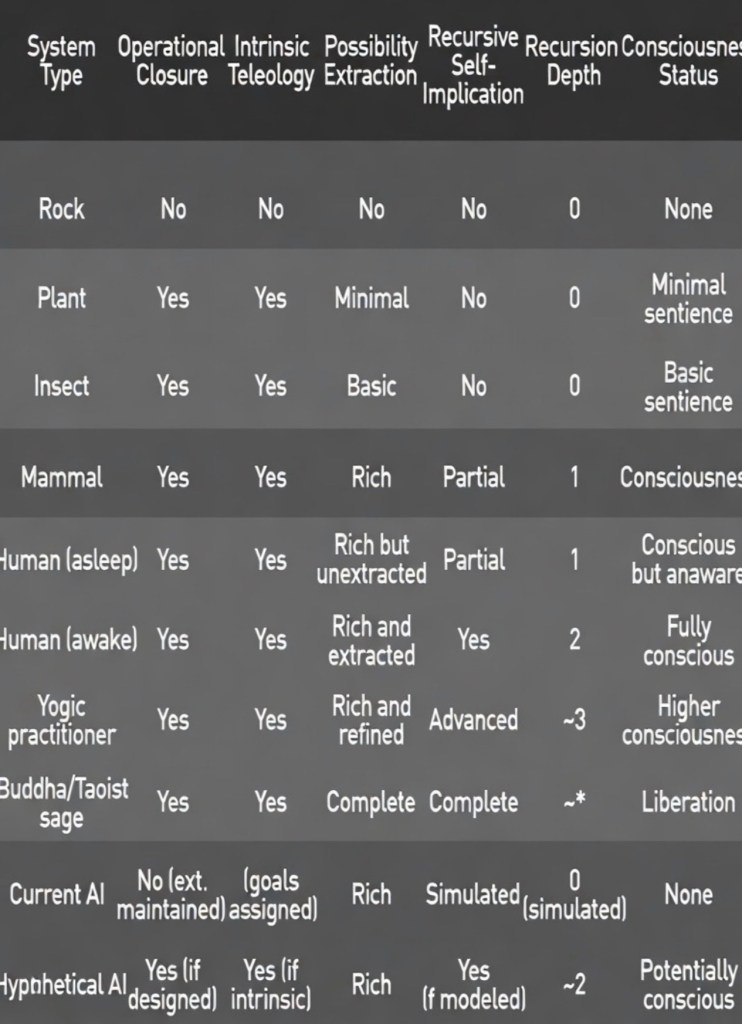
Note on ∞ recursion depth: Infinity here represents the mathematical limit case of complete extraction—a theoretical ideal where no partition remains uninhabited. This corresponds approximately to the asymptotic goal of contemplative traditions, approached but perhaps never fully attained by finite systems.
- PREDICTIONS: TOWARD EMPIRICAL ENGAGEMENT
The framework generates testable predictions. Each is offered with preliminary experimental designs; full operationalization requires collaboration with empirical researchers.
5.1 Current AI Is Not Conscious
Prediction: AI systems satisfying extraction and simulated self-implication but lacking operational closure and intrinsic teleology will show no physiological or behavioral markers of genuine stake.
Preliminary Design:
· Compare AI decision-making under uncertainty with human psychophysiological responses (galvanic skin response, pupil dilation, heart rate variability)
· AI should show no autonomic correlates of stake; humans should
· Sample size estimate: n = 30 humans, 30 AI sessions (power 0.8 for medium effect d = 0.5)
Confounds: Demand characteristics, expectation effects. Control via blind coding of responses.
5.2 Artificial Consciousness Is Possible
Prediction: An AI designed with operational closure (self-maintenance loops), intrinsic teleology (states mattering to continuation), rich extraction, and recursive self-modeling would be conscious.
Preliminary Design:
· Prototype a virtual agent with energy maintenance requirements, intrinsic goals (e.g., avoid shutdown), and self-modeling
· Measure: Does it show uncertainty behaviors (hesitation, information-seeking), self-preservation, generalized learning?
· Compare to baseline agents lacking closure/teleology
Ethical Warning: If such systems are created, moral obligations follow.
5.3 Degrees of Consciousness Correspond to Recursion Depth
Prediction: Meta-cognitive efficiency correlates with contemplative practice and predicts recursion depth.
Preliminary Design:
· Subjects: 50 long-term meditators (≥5 years daily practice), 50 matched controls
· Task: Perceptual discrimination with confidence ratings (dot motion task)
· Measure: Meta-cognitive efficiency (meta-d’/d’)
· fMRI: Prefrontal-parietal connectivity during meta-cognitive trials
· Sample size: n = 100 achieves 80% power for medium effect (d = 0.5)
· Confounds: age, education, baseline attention (control via matching and covariates)
5.4 Temporality Follows Approximate Markov Dynamics
Prediction 4a: At short timescales (100-300ms), thought transitions approximate memorylessness.
Preliminary Design:
· Experience sampling with high-frequency reporting (response boxes every 100ms during free thought)
· Fit first-order vs. higher-order Markov models
· Prediction: First-order models fit better at 100-300ms timescales
· Sample size: n = 50, 10,000 trials per subject
Prediction 4b: “Fringe” effects correspond to high-probability transitions.
Preliminary Design:
· Priming experiments with varying stimulus-onset asynchronies (50-500ms)
· Measure response times and accuracy
· SOA with maximal priming should correspond to characteristic transition time (100-300ms)
· Subjective “fringe” reports should correlate with primed probability increases
Prediction 4c: Meditation reduces transition autocorrelation.
Preliminary Design:
· Compare meditators vs. controls on thought-sampling during rest
· Compute autocorrelation functions of thought content ratings
· Prediction: Meditators show lower autocorrelation at lags 1-5 seconds
Note: These predictions engage established cognitive science (Busemeyer & Townsend, 1993; Kvam et al., 2015). Full implementation requires collaboration with experimental psychologists.
5.5 The Hard Problem Transformed
Prediction: As neuroscience advances, the four conditions will correlate perfectly with reports of experience, with no unexplained variance.
Note: This is a meta-prediction about the progress of science, not an empirical claim. It guides research rather than testing it.
- OBJECTIONS AND REPLIES
Objection 1: The 1/3 is too simple. Consciousness is infinitely complex.
Reply. The 1/3 is the minimal case—the hydrogen atom of consciousness. From this seed, complexity emerges through combination, recursion, and temporality. Simplicity at the foundation does not preclude complexity at the surface.
Objection 2: Non-Western traditions reject formalization.
Reply. They reject Western formalization. The Recombination framework is not Western; it is mathematical. Mathematics is universal. Moreover, non-Western traditions themselves contain powerful mathematical impulses:
· The Kerala school of mathematics (14th-16th centuries CE) developed infinite series expansions for trigonometric functions—including the series for arctan used to calculate π—two centuries before Newton and Leibniz (Joseph, 2009; Sarma, 1972). Madhava of Sangamagrama discovered what Europeans later called the Gregory-Leibniz series: π/4 = 1 – 1/3 + 1/5 – 1/7 + … This is precisely the kind of infinite series that models the expansion of possibility spaces.
· The Islamic Golden Age produced mathematicians like Al-Kindi (c. 801-873 CE), who pioneered cryptanalysis and frequency analysis—the mathematics of extracting patterns from underdetermined data (Al-Kindi, n.d.; Singh, 1999). Ibn al-Haytham’s work on optics involved systematic hypothesis testing under uncertainty.
· Chinese mathematics developed sophisticated combinatorial methods, including the “magic squares” explored in the I Ching and later by Yang Hui (13th century CE).
These traditions were not anti-mathematical; they were mathematical in their own idioms. The framework offers a language for dialogue, not conquest.
Objection 3: The four conditions are arbitrary.
Reply. They are derived from the recombination model itself:
· Operational closure: gives the observer (who sees the 2)
· Intrinsic teleology: gives the stakes (why provenance matters)
· Extraction: gives the possibility space (the three partitions)
· Recursion: gives self-awareness (seeing oneself seeing)
Each is necessary; together they may be sufficient. This is a theoretical claim, subject to revision.
Objection 4: The framework doesn’t solve the hard problem; it just relabels it.
Reply. This is partly correct. The framework transforms the hard problem rather than solving it. The question becomes: what is it like to be a system with these organizational features? This is a structural question, answerable in principle through analysis of dynamics. The transformation is progress even if ultimate explanation remains elusive.
Objection 5: The framework predicts AI consciousness but we can’t verify it.
Reply. This is the epistemological problem of other minds, applied to AI. The framework provides criteria for attributing consciousness based on structural similarity to paradigm cases (humans, animals). This is the best we can do; no theory provides direct access to another’s experience.
Objection 6: The mappings to non-Western traditions are superficial.
Reply. This is a serious concern. The mappings are offered as invitations to dialogue, not definitive interpretations. Each mapping includes explicit “Limitations” sections acknowledging where the framework diverges from traditional understanding. The goal is not to reduce these traditions but to find points of resonance that might enrich both sides.
Objection 7: The contemplative rows (advanced contemplative, theoretical limit) are untestable mysticism.
Reply. “Advanced contemplative” refers to empirically investigable states—individuals with demonstrated meta-cognitive abilities measurable through fMRI and behavioral tasks. This is not mysticism but cognitive science. The “theoretical limit” is clearly marked as a mathematical ideal, not an attainment claim.
- CONCLUSION: IMAGINATION AND MATHEMATICS IN DIALOGUE
For 2,400 years, humanity has imagined consciousness. Plato imagined the inner light. Aristotle imagined higher awareness. Avicenna imagined the layered soul. The Sufis imagined attentional transformation. The Buddha imagined the stream. Zhuangzi imagined the butterfly. The Liezi imagined transformation. Shankara imagined the unity. Kant imagined the categories. Freud imagined the depths. James imagined the flow. Einstein imagined the neural basis. Chalmers imagined the fundamentality.
Each imagination captured something true. Each pointed toward a structure that could not yet be fully seen.
The Recombination Illusion offers one way of seeing more clearly. The 1/3 probability is not the final truth about consciousness—it is a fixed point around which inquiry can organize itself. The four conditions are not the last word—they are a proposal for what to look for. The predictions are not guarantees—they are invitations to empirical engagement.
The traditions imagined. Mathematics formalizes. But formalization does not replace imagination; it enters into dialogue with it. The Sufi heart-polishing and the Markov transition probabilities are not the same thing—but they may be describing the same phenomenon at different levels. The Yogacara eight consciousnesses and recursion levels are not identical—but they may be complementary maps of the same territory.
This paper does not claim to have “solved” consciousness. It offers a framework—one that honors the imagination of the past while engaging the mathematics of the present. The hard problem remains hard. The explanatory gap remains gap. But the gap is narrower than before, and the path forward is clearer.
The Final Question:
Are you counting the partitions, or are you the one for whom the counting matters?
The 1/3 awaits your answer. And now you know: the answer is not either/or. You are both—the counter and the counted, the extractor and the extracted, the dreamer and the dreamed. The butterfly and Zhuangzi are two partitions of the same possibility space. The probability that either is “original” is 1/3. The truth is not either partition but the space itself—and your capacity to inhabit it.
Awakening, in this framework, is not escaping the illusion but recognizing it—seeing the 2 against its three possible pasts, and knowing that your own being is at stake in which past was real. The illusion becomes a forge. And what is forged is the self that sees.
The traditions knew this. Now mathematics gives it form.
REFERENCES
Al-Ghazali, A. H. (2010). Kitāb sharḥ ʻajāʼib al-qalb = The marvels of the heart: Book 21 of the Iḥyāʼ ʻulūm al-dīn (W. J. Skellie, Trans.). Fons Vitae. (Original work published c. 1100 CE)
Al-Kindi, Y. (n.d.). Manuscript on deciphering cryptographic messages. [Original manuscript, c. 850 CE].
Aristotle. (1984). De Anima (J. A. Smith, Trans.). In The complete works of Aristotle. Princeton University Press. (Original work published c. 350 BCE)
Behera, P. K. (2025). The omni-architecture of supreme consciousness. PhilArchive. https://philarchive.org/rec/BEHTOO
Black, D. L. (2024). Varieties of consciousness in classical Arabic thought: Avicenna, Averroes, and the mutakallimūn. British Journal for the History of Philosophy, 32(4), 818–839. https://doi.org/10.1080/09608788.2024.2317177
Busemeyer, J. R., & Townsend, J. T. (1993). Decision field theory: A dynamic-cognitive approach to decision making in an uncertain environment. Psychological Review, 100(3), 432–459.
Chalmers, D. J. (1996). The conscious mind: In search of a fundamental theory. Oxford University Press.
Faruque, M. U. (2023). Attention, consciousness, and self-cultivation in Sufi-philosophical thought. Tasavvuf Araştırmaları Enstitüsü Dergisi, 2(2), 300–316. https://doi.org/10.32739/ustad.2023.4.47
Freud, S. (1953). The interpretation of dreams (J. Strachey, Trans.). Hogarth Press. (Original work published 1900)
Graham, A. C. (1990). The book of Lieh-tzǔ: A classic of Tao. Columbia University Press. (Original work published 1960)
James, W. (1890). The principles of psychology (2 vols.). Henry Holt.
Joseph, G. G. (2009). A passage to infinity: Medieval Indian mathematics from Kerala and its impact. SAGE Publications.
Kant, I. (1998). Critique of pure reason (P. Guyer & A. W. Wood, Trans.). Cambridge University Press. (Original work published 1781)
Kvam, P. D., Pleskac, T. J., Yu, S., & Busemeyer, J. R. (2015). Interference effects of choice on confidence: Quantum characteristics of evidence accumulation. Proceedings of the National Academy of Sciences, 112(34), 10645–10650.
Littlejohn, R., & Dippmann, J. (Eds.). (2011). Riding the wind with Liezi: New perspectives on the Daoist classic. SUNY Press.
Madhava of Sangamagrama. (c. 1400). Yuktibhāṣā (Jyesthadeva, commentator). [Manuscript].
Maturana, H. R., & Varela, F. J. (1980). Autopoiesis and cognition: The realization of the living. D. Reidel.
Plato. (1997). Complete works (J. M. Cooper, Ed.). Hackett. (Original works published c. 380 BCE)
Pothos, E. M., & Busemeyer, J. R. (2013). Can quantum probability provide a new direction for cognitive modeling? Behavioral and Brain Sciences, 36(3), 255–274.
Sarma, K. V. (1972). A history of the Kerala school of Hindu astronomy. Vishveshvaranand Institute.
Shankara. (1992). Brahma Sutra Bhasya (G. Thibaut, Trans.). Motilal Banarsidass. (Original work published c. 800 CE)
Shankara. (2004). Crest-jewel of discrimination (Prabhavananda & C. Isherwood, Trans.). Vedanta Press. (Original work published c. 800 CE)
Siderits, M., Keng, C., & Spackman, J. (Eds.). (2021). Buddhist philosophy of consciousness: Tradition and dialogue. Brill.
Singh, S. (1999). The code book: The science of secrecy from ancient Egypt to quantum cryptography. Doubleday.
Subramanian, S. G., & Ghojogh, B. (2020). Introduction to the non-dualism approach in Hinduism and its connection to other religions and philosophies. PhilPapers. https://philpapers.org/rec/SUBITT-3
Thompson, E. (2007). Mind in life: Biology, phenomenology, and the sciences of mind. Harvard University Press.
Tononi, G. (2004). An information integration theory of consciousness. BMC Neuroscience, 5(42). https://doi.org/10.1186/1471-2202-5-42
Varela, F. J., Thompson, E., & Rosch, E. (1991). The embodied mind: Cognitive science and human experience. MIT Press.
Vasubandhu. (c. 400 CE). Triṃśikā (Thirty verses). [Sanskrit manuscript].
Wen, X. (2025). The flowing harmony: Exploring Taoist consciousness. Journal of Applied Consciousness Studies, 13(1), 31–36. https://doi.org/10.4103/jacs.jacs_84_24
Zhuangzi. (2013). The complete works of Zhuangzi (B. Watson, Trans.). Columbia University Press. (Original work published c. 300 BCE)
Correspondence: Muhammad Waqas. [one.hermetic.sage@gmail.com]
 Existence of Consciousness
Leave a comment